
Mountain Kilimanjaro
Mount Kilimanjaro is a massive dormant volcano located in Tanzania and it is the tallest peak in Africa and the tallest free-standing mountain above sea level in the world, at 5,895 m (19,341ft) above sea level and 4,900 m (16,100 ft) above its plateau base. In addition, it is the fourth most notable mountain on Earth and the tallest volcano in the Eastern Hemisphere.
The enormous dormant stratovolcano known as Mount Kilimanjaro formerly had three distinct volcanic cones namely: Kibo, Shira, and Mawenzi. Kibo is both the highest and center cone at 5985 meters and this is where Kilimanjaro’s peak lies. It was formed 460,000 years ago and it is a dormant volcano. After Mount Kenya and Kibo, Mawenzi which is a rugged summit is the third highest peak in Africa at 5149 m above sea level and you will enjoy nice views of Mawenzi on the Rongai and Northern Circuit routes. Shira is not anymore, a peak and it is thought to have been roughly 16,000 feet high when it collapsed, making the Shira Plateau on the west side of the mountain. Kilimanjaro Mountain has treks like Machame, Lemosho, Rongai, Mrangu, Ubwe, Northern circuit routes and Shira trails trek across this feature.
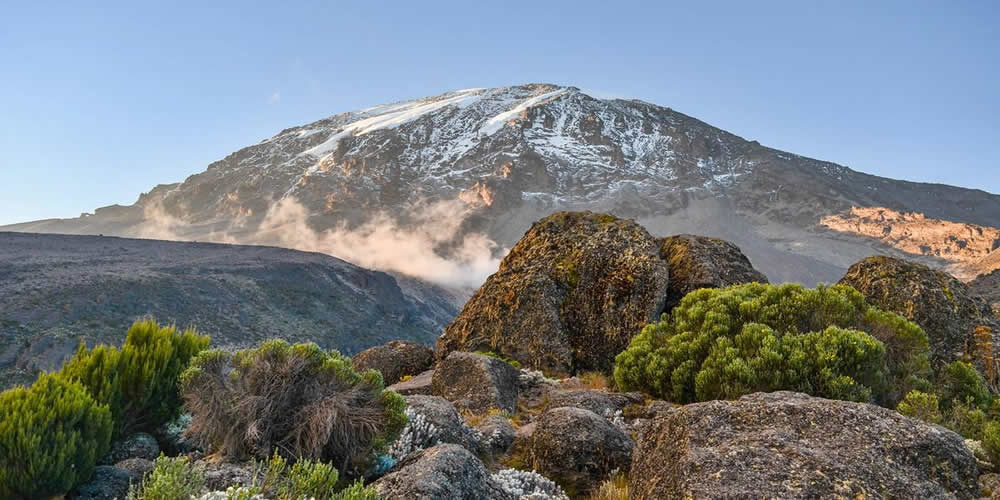
Based on a British survey conducted in 1952, the highest peak on the rim of Kibo’s crater is Uhuru Peak, whose height is listed as 5,895 meters (19,341 feet) by both the United Nations Educational, Scientific, and Cultural Organization and the Tanzanian government’s Tanzania National Parks Authority.
The distance between Mount Kilimanjaro and the equator is only 205 kilometers which made many to be skeptical of early explorers when they claimed to have seen glaciers on mountain Kilimanjaro because they believed ice would not form so close to the scorching equatorial sun, the mountain contains vast stretches of ice glaciers and draws tourists from all around the world, and scientists are currently believing that the glaciers decrease and then expand over the planet’s ice ages.
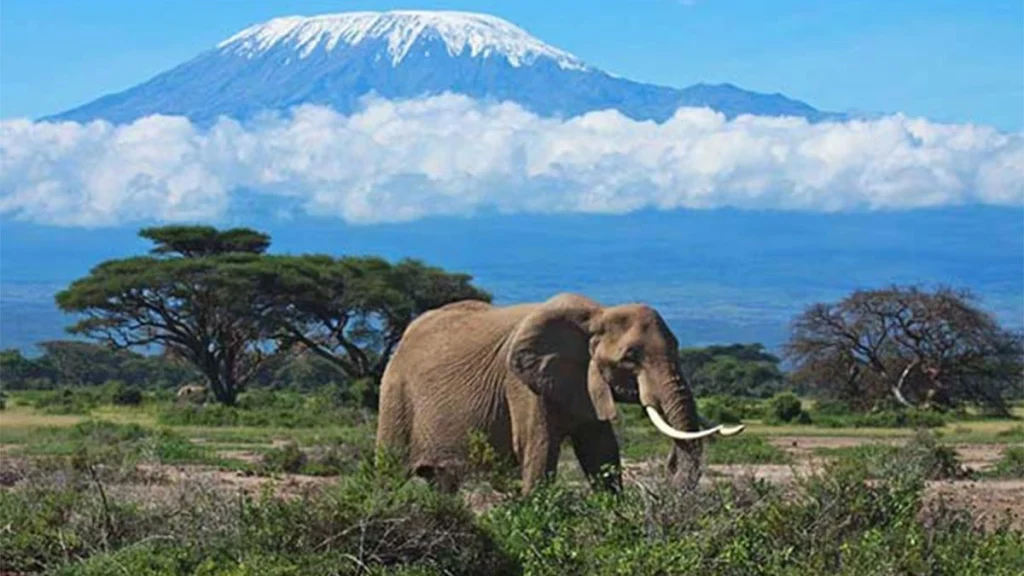
Kilimanjaro is pretty beautiful, especially when you look at its ‘white cap’ from a distance. You can see from Arusha, Moshi, and even from Kenya. Yes, the Amboseli National Park offers unobstructed views of this wonderful volcano. The views are even clearer from the park’s observation hill.
However, viewing and climbing Kilimanjaro are two quite different things. While everyone can view from any point where it’s visible, climbing is not for everyone. This is because you need courage and enough physicality to conquer Africa’s highest mountain. Additionally, timing is quite essential for a successful climb. In this article, we’ll highlight the best time to go hiking and other relevant information. So, let’s dive in! Kilimanjaro is Africa’s tallest peak and the world’s tallest freestanding mountain. It’s also among the world’s seven summits and the natural wonders of Africa. This beautiful mountain is 5,895 meters high, beating all peaks in Africa.
Dry season
The dry season is the best time to climb the Kilimanjaro. It takes place from June to October. June – October is considered to be the best time to climb the Kilimanjaro. It is warm and very stable with little or no rain and many climbers prefer this season.
From January to March, there is little or no rain. It is called the short dry season. It is characterized by cooler temperatures and usually fewer crowds attempt Kilimanjaro during this time. There is a high chance of snow, making the summit cooler but very beautiful.
Another good thing about the dry season is the greater visibility of Mt. Kilimanjaro. You’ll enjoy magnificent views of Mt. Kilimanjaro on a clear day.
 Rainy season
The rainy season starts in November and ends in May. This season can be divided into a long rainy season and a short rainy season. The long rainy season is from April to May. It’s characterized by heavy rainfall, making the trails slippery, and most days are cloudy. As a result, a few climbers try to climb this greatest African mountain.
The short rainy season is from November to early December. During this time, rain is short and less frequent. Therefore, the Kilimanjaro trail is accessible.
Temperature. Days are hot while nights are cooler and even freezing. Bring the right clothing; light clothing for the day and heavy ones for the night. The temperature drops drastically as you approach the summit.
Wildlife. Kilimanjaro hosts various animal species on its slopes. Animals concentrate at lower altitudes during the rainy season. If seeing animals during the climb is what you want, you should plan your hike in the rainy season.
Conquering Kilimanjaro: Success tips.
Kilimanjaro is a walk-up trek because no technical climbing skills are needed to climb it. But that doesn’t mean it is such easy, it’s tough, and many climbers have failed to reach the Uhuru Peak (5895m). Here are some success tips for your next adventure on Africa’s largest mountains.
Train beforehand; Kilimanjaro is a challenge even when hiked in the dry season. So, hit the gym, train your muscles, run, lift weights, etc. If you’ve never been to higher altitudes, make yourself familiar with them. Hike Mount Meru before hiking Kilimanjaro.
Bring the right thing: Having all that is needed ready at your disposal makes you feel comfortable. Kilimanjaro’s nights are colder while days are hotter. Always pack clothes for both conditions. Never forget hiking boots, binoculars, and a good camera.
Book early; Most of the climbing happens in the dry season – a more competitive period. Prior booking is very important, otherwise you may miss the best offers.
Plan with a reputable guide. Be careful with whom you’re trusting for your hike. Be sure he/she is worth your trust. Always check reviews on sites like TripAdvisor and hear what previous clients have to say about the guide or tour operator.
Final thoughts: You can climb Kilimanjaro anytime you want because it’s good year-round. The best time to experience it depends on your interests and timeline. Clear skies, fewer crowds, or an adventurous challenge all make your hike unique and unforgettable. Decide on which one you would like to experience.
 Are you planning to walk up Kilimanjaro? At 4×4 Adventures, we make every safari unforgettable. Reach out to a team of experts to start your plan. Good luck!
It depends on what you want to experience. If you don’t like hiking with the crowd, then plan your hike from January to March or in November. But if the photograph is your thing, then January – March is better. The snow is plenty at the top making photographing ideal. Additionally, June – October is characterized by clear skies. You can enjoy the blue view of the horizon as you hike.
Experienced hikers can try the rainy season. The slippery makes the journey more challenging, which is a good thing for adventurers. There are also fewer crowds,
For warmer weather and great views, June to October is the right time. You’ll enjoy scenic views of Kilimanjaro’s summit since the sky is always clear. There are also no frequent rains, making your hike uninterrupted.
What to consider when planning your Kilimanjaro hike
Crowds. During the high season, the Kilimanjaro receives many hikers. So, expect to catch up with other hikers, make new friends, and celebrate the milestones together. Imagine shooting a funny video while on the trail and in the middle of it, someone crosses by. You can avoid the crowd by planning your trip in the low season.
Costs. The high season is also expensive because competition is high. Since everyone wants a slot to hike Kilimanjaro, permits, tours, and other services may be overpriced. This season is, therefore, not good for budget travelers.
Ecological Zone in Mountain Kilimanjaro.
Hiking Mount Kilimanjaro is an adventure across radically shifting ecological systems, spanning from dense forests to alpine deserts and icy glaciers and the mountain’s distinct position which is close to the equator allows hikers encounter an array of climates and vistas in a matter of days. Every trail provides a slightly distinct approach, and the Rongai Route, renowned for its remote and scenic ascent, offers a unique viewpoint on Kilimanjaro’s ecosystems. When hiking Kilimanjaro, hikers will traverse five different ecological zones on their route to the top. These include:
-
Bushland/Cultivated Zone (800m-1,800m)
- This is the first zone that consists of small towns, farmlands and homes to people who cultivate crops including maize, coffee, and bananas. The rolling hills and wide vistas give a smoother start.
-
Rainforest Zone 1,800m-2,800m
- After departing the farmlands, the route right away reaches Kilimanjaro’s rainforest which contain lush, foggy jungle full of tall trees, moss-covered trunks, and various fauna. This habitat thrives owing to abundant rainfall and mild temperatures, generating a vibrant green environment but on the Rongai Route, the rainforest is less vast than on the southern routes, but you may still witness animals such as colobus monkeys, blue monkeys, and a variety of bird species. This zone is also home to Kilimanjaro’s abundant vegetation with huge ferns and the occasional wildflowers bordering the
-
Heath/Moorland Zone 2,800m-4,000
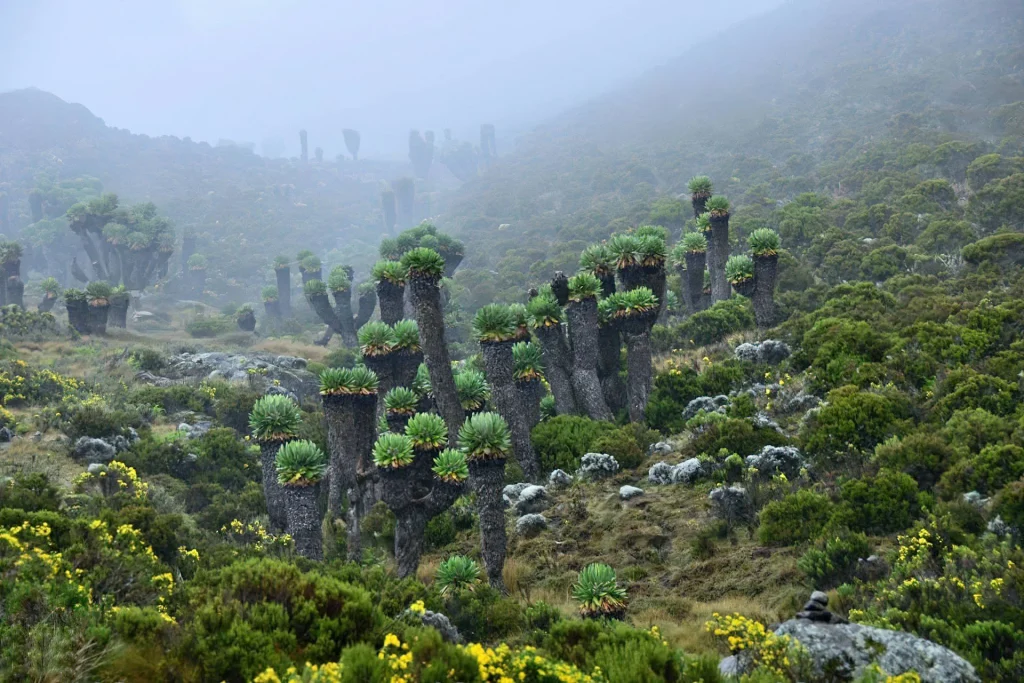
- As you ascend higher, the rainforest gives place to the moorland zone, where flora becomes sparser, the towering trees fade as they are replaced by huge lobelias and groundsels which are plants that are accustomed to Kilimanjaro’s severe high-altitude environment. This zone is typically described as an unearthly environment, with undulating hills, rocky outcrops, hazy valleys and the nights may get rather chilly when the temperature starts to drop so this area which offers breathtaking views of the peak towering above, is traversed by tourists for many days.
-
Alpine Desert Zone (4,000–5,000m)
- Kilimanjaro’s environment turns into a severe alpine desert at higher altitudes with the area being arid, stony, and desolate, and just a few hardy florae able to endure the high temperature swings and strong winds. In this zone there are amazing vistas with huge, open terrain reaching toward the top. Hiking gets increasingly difficult due to the thin air and rising altitude, yet this stretch is unforgettable because of the breathtaking landscape and beautiful night skies.
-
Arctic Summit Zone (5,000–5,895m)
- The arctic zone is the last portion of Kilimanjaro’s summit with temperatures that frequently fall far below freezing and oxygen levels that are around half of the amount they are at sea level. The topography here comprises of glaciers, ice fields, and volcanic rock making the views from Uhuru peak to be breathtaking despite the severe climate since because of the views of sweeping panoramas of the African plains beneath and the remnants of Kilimanjaro’s dwindling glaciers. The Rongai Route approaches the summit via Gilman’s Point, a hard but rewarding hike to the highest point in Africa.
What is the best and worst time to hike mountain Kilimanjaro.
The best season to visit mountain Kilimanjaro is during dry season and worst time to hike mountain Kilimanjaro is during wet season.
Dry season.
The dry season is the most ideal time to hike mountain Kilimanjaro. It takes place from June to October which is regarded to be the optimum period to hike mountain Kilimanjaro because it is warm and extremely steady with no or little rainfall and many hikers favor this season. From January to March, there is little or no rain. It is termed the brief dry season. It is marked by lower temperatures and generally fewer crowds tackle Kilimanjaro during this season. There is a significant likelihood of snow, making the peak chilly but extremely attractive. Another beneficial aspect about the dry season is the better visibility of Mt. Kilimanjaro. You will get outstanding views of Mt. Kilimanjaro on a bright day.
The rainy season.
The rainy season commences in November and finishes in May. This season may be separated into a lengthy wet season and a short rainy season. April through May is the lengthy wet season. It’s marked by excessive rainfall, making the paths treacherous, and most days are overcast. As a result, a few climbers try to ascend this biggest African peak. November to early December is the brief wet season. Throughout this time, rain is brief and less frequent so the Kilimanjaro path is accessible.
Tips for hiking mountain Kilimanjaro.
Kilimanjaro is a straightforward journey since no technical climbing abilities are needed to ascend it. But it doesn’t imply it is so simple because it’s arduous, and many hikers have been unable to reach the Uhuru Peak (5895m). Here are some great recommendations for your next expedition on Africa’s tallest mountains.
Train beforehand; Kilimanjaro is a difficult even when done in the dry season. Make sure you go to the gym to strengthen your muscles, run, and lift weights among others to prepare yourself for the challenging mountain Kilimanjaro hiking, you should also learn about greater altitudes if you have never been there. Hike Mount Meru before hiking Kilimanjaro.
Bring the correct items: Make sure you pack the right items that will help you have a successful hike like packing for Kilimanjaro’s cooler evenings with hotter days and carry along hiking boots, binoculars, and a good camera to make your safari phenomenal. Make reservations in advance during the dry season which is more competitive because it is when most hiking takes place so this is crucial to avoid missing the greatest deals.